
MOTS-c
The Mitochondrial-Encoded Peptide for Metabolic Youth
MOTS-c (Mitochondrial Open Reading Frame of the 12S rRNA Type-C) is a mitochondria-derived peptide (MDP) encoded within the mitochondrial genome. Discovered by Pinchas Cohen in 201...
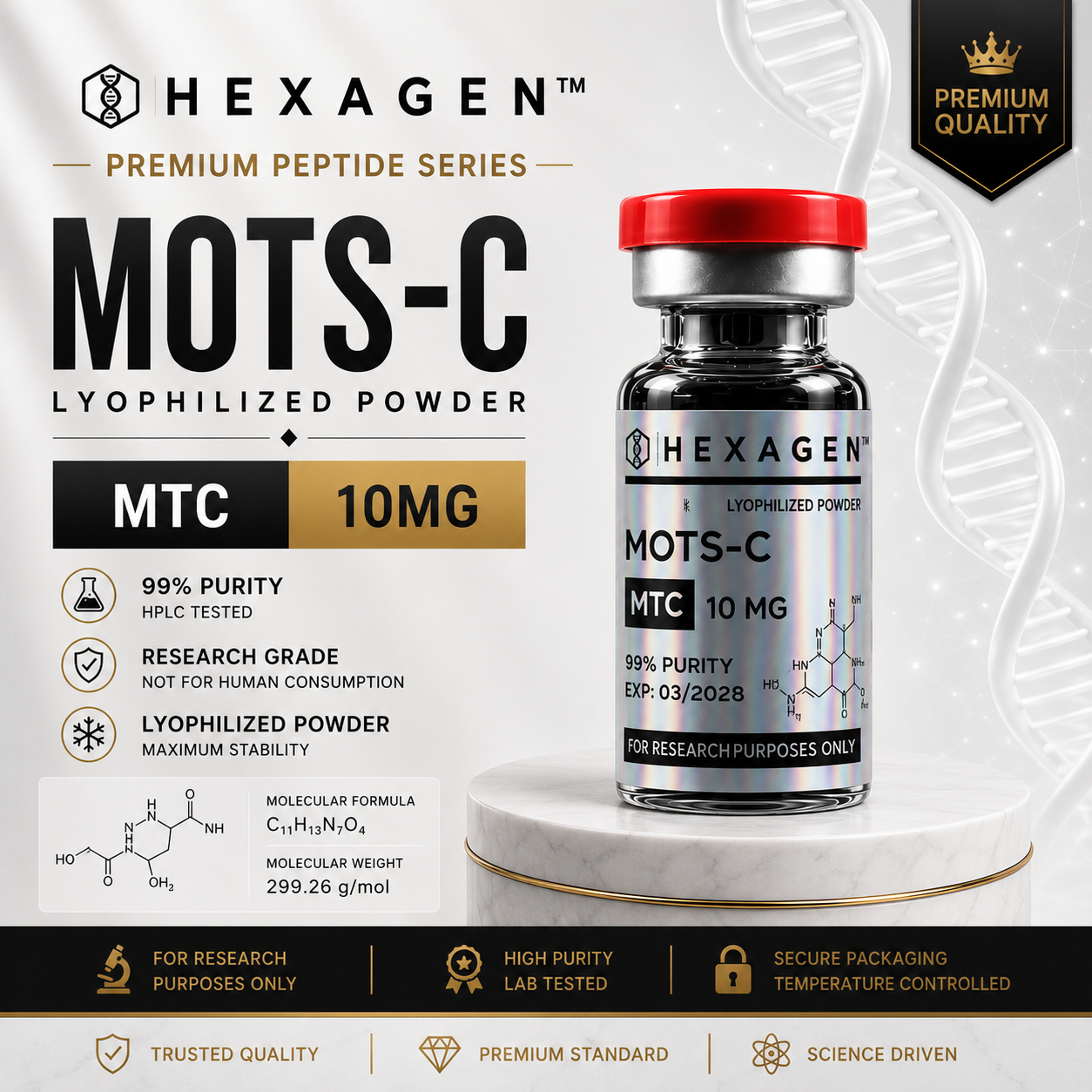
Formula
C92H152N26O26S
Molecular Weight
2174.44 g/mol

What is this compound?
MOTS-c (Mitochondrial Open Reading Frame of the 12S rRNA Type-C) is a mitochondria-derived peptide (MDP) encoded within the mitochondrial genome. Discovered by Pinchas Cohen in 2015, it is translocated to the nucleus during metabolic stress where it regulates adaptive gene expression, insulin sensitivity, and metabolic homeostasis. It declines significantly with age.
Insulin sensitivity and glucose metabolism restoration
Regulation of folate cycle and AMPK activation
Exercise mimetic effects on skeletal muscle
Obesity and metabolic syndrome research
Anti-aging metabolic effects matching younger physiological patterns
Stress response and resilience enhancement
How it works
MOTS-c activates AMPK (AMP-activated protein kinase) and translocates to the nucleus under stress where it regulates nuclear gene expression. It inhibits the folate cycle and de novo purine biosynthesis, channeling resources to AMPK-mediated metabolic adaptation. It also modulate...
Research imagery

Visual overview
Areas of investigation
Discovery to present
2015
Discovery
MOTS-c was first identified and characterized in research contexts.
2000s
Research
Preclinical studies expanded across multiple tissue types and disease models.
2010s
Clinical Progress
Early-stage research progressed toward translational and clinical investigation.
2024+
Current Interest
Active research continues with growing scientific interest and expanding publication volume.
Knowledge connections
Explore how MOTS-c connects to mechanisms, research goals, related compounds, and scientific references.
Research calculations
Plan research protocols with precise reconstitution, dosing, and unit conversion tools.
Reconstitution Calculator
Bacteriostatic water ratios
Dose Calculator
Precise microgram dosing
Unit Converter
Syringe unit conversions
Compare with similar compounds


Frequently researched together
These compounds are commonly studied alongside MOTS-c for complementary mechanism effects.
Loading...
Loading...
Primary literature
Reference compilation in progress. See research highlights below.
University of Southern California research demonstrates exercise-mimetic effects in sedentary mice
University of Southern California research demonstrates exercise-mimetic effects in sedentary mice
Circulating levels in humans shown to decline progressively with age
Circulating levels in humans shown to decline progressively with age
Obesity studies show prevention of diet-induced weight gain and insulin resistance
Obesity studies show prevention of diet-induced weight gain and insulin resistance
MOTS-c — Frequently asked
MOTS-c (Mitochondrial Open Reading Frame of the 12S rRNA Type-C) is a mitochondria-derived peptide (MDP) encoded within the mitochondrial genome. Discovered by Pinchas Cohen in 2015, it is translocate... MOTS-c belongs to the Anti Aging research category and is studied for its the mitochondrial-encoded peptide for metabolic youth.
MOTS-c activates AMPK (AMP-activated protein kinase) and translocates to the nucleus under stress where it regulates nuclear gene expression. It inhibits the folate cycle and de novo purine biosynthesis, channeling resources to AMPK-mediated metabolic adaptation. It also modulates insulin receptor substrate signaling.
Insulin sensitivity and glucose metabolism restoration. Regulation of folate cycle and AMPK activation. Exercise mimetic effects on skeletal muscle. Obesity and metabolic syndrome research. Anti-aging metabolic effects matching younger physiological patterns. Stress response and resilience enhancement.
MOTS-c has the molecular formula C92H152N26O26S and a molecular weight of 2174.44 g/mol. This structural information is important for researchers studying receptor binding and pharmacokinetics.
University of Southern California research demonstrates exercise-mimetic effects in sedentary mice Circulating levels in humans shown to decline progressively with age Obesity studies show prevention of diet-induced weight gain and insulin resistance These findings are based on preclinical and clinical research. MOTS-c is a research compound and these studies do not constitute medical advice.
No. MOTS-c is not FDA-approved for any indication. It is a research chemical studied in preclinical and early clinical research. These compounds are not approved for human therapeutic use and should only be studied in appropriate research settings.
MOTS-c belongs to the Anti Aging category, which focuses on peptides researched for their telomere-supporting, mitochondrial-protective, and senolytic properties aligned with healthy longevity science. You can explore more compounds in this category on the Anti Aging pillar page.
Add to your cart
Select a variant to add MOTS-c to your cart for comparison, protocol planning, and AI-assisted analysis.
Available Variants
Research Disclaimer
MOTS-c is a research compound. All information is for educational and research purposes only. Not intended for human or animal consumption. Not intended to diagnose, treat, cure, or prevent any disease.